Customer Service
We firmly believe that we offer THE BEST customer support in the industry and it is our ongoing goal to continually improve on our services. As an independently owned and operated business, we are able to provide the most accommodating service possible.
Professional Team
We have a team of skilled and experienced professionals who are well-versed in the latest technology and industry standards. Our team is dedicated to ensuring that our customers get the best service and support possible.
Competitive Prices
We offer our products at competitive prices, making them affordable for our customers. We believe that high-quality products should not come at a premium, and we strive to make our products accessible to all.
High Quality Products
We always put customer needs and expectations in the first place, refine on, continuous improvement, to seek every opportunity to do better, to provide customers with their expectations of quality products, to provide customers with the most satisfactory service at anytime.
Quality Control
All goods will undergo strict quality inspection before shipment. MCC always insists on providing high-quality products. We firmly believe that quality is the basis of everything.
Healthcare and Hygiene
The high absorbency, softness, and comfort of wood pulp spunlace nonwoven fabrics make them ideal for various healthcare and hygiene products. They are extensively used in manufacturing surgical gowns, drapes, wipes, bandages, and personal hygiene products such as diapers and feminine hygiene products.
Industrial Wipes
Thanks to their superior absorbency and durability, these nonwoven fabrics are perfect for making industrial wipes used for cleaning machinery, equipment, and workspaces in various industries.
Automotive
The nonwoven fabric' s strength and durability make it suitable for various automotive applications, including as soundproofing material and for interior surfaces.
Home Furnishing
With their versatility, wood pulp spunlace nonwoven fabrics can be used for making various home furnishing items like table cloths, napkins, and upholstery.
Packaging
The strength and biodegradability of these fabrics make them an attractive option for eco-friendly packaging solutions.
Filtration
The nonwoven fabrics' structure allows them to act as effective filters, making them suitable for applications in water purification, air filtration, and other related areas.


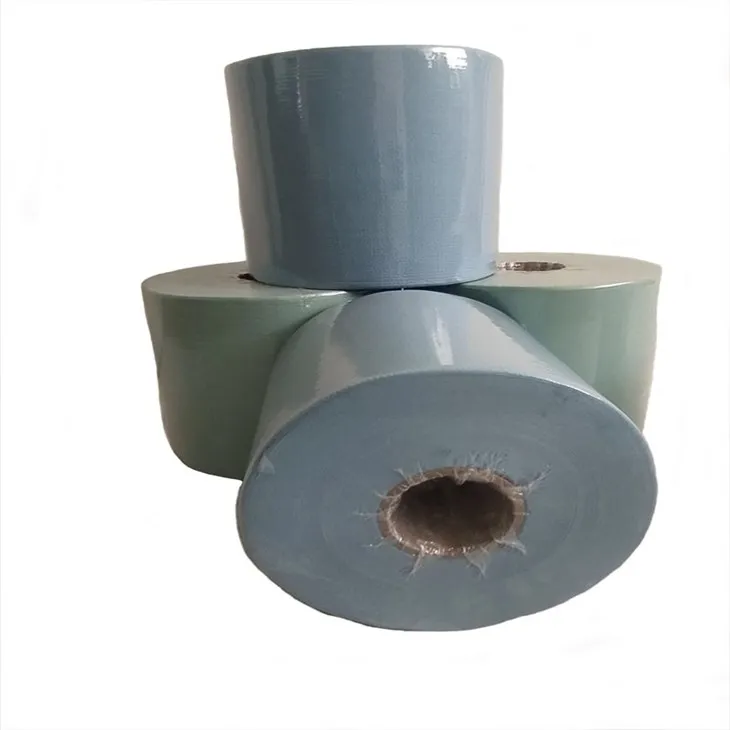
Lightweight
Using polypropylene resin as the main raw material, the specific gravity is only 0.9, only three-fifths of cotton, with fluffy and good hand feeling.
Soft
Composed of fine fibers (2-3D) light point-like hot melt bonding molding. The finished product is moderately soft and comfortable.
Water Repellent, Breathable
Polypropylene chips do not absorb water, have zero moisture content, and the finished product has good water repellency. It is composed of 100% fiber, which is porous and has good air permeability. It is easy to keep the cloth dry and easy to wash.
Non-toxic And Non-irritating
The product is produced with FDA-compliant food-grade raw materials, without other chemical ingredients, with stable performance, non-toxic, no peculiar smell, and does not irritate the skin.
Anti-chemical Agents
Polypropylene is a chemically inert substance, not moth-eaten, and can isolate the erosion of bacteria and insects in the liquid.
Antibacterial Properties
The product is water-repellent, not moldy, and can isolate the erosion of bacteria and insects in the liquid, and is not moldy.
Good Physical Properties
It is made of polypropylene spun directly into a mesh and thermally bonded. The strength of the product is better than that of the general staple fiber product, the strength is non-directional, and the vertical and horizontal strengths are simi
Environmental Protection
In terms of environmental protection, the raw material of most non-woven fabrics used is polypropylene, while the raw material of plastic bags is polyethylene. Although the two substances have similar names, they are quite different in chemical structure. The chemical molecular structure of polyethylene is quite stable and extremely difficult to degrade, so it takes 300 years for plastic bags to decompose; while the chemical structure of polypropylene is not strong, the molecular chain can be easily broken, so that it can be effectively degraded , and enter the next environmental cycle in a non-toxic form, a non-woven shopping bag can be completely decomposed within 90 days. Moreover, non-woven shopping bags can be reused more than 10 times, and the pollution to the environment after disposal is only 10% of that of plastic bags.
Wood pulp polyester and wood pulp PP (polypropylene) are two of the most common materials used in nonwovens, which are commonly used in a wide range of industries. Although both materials may seem similar, there are distinct differences between them.
Firstly, wood pulp polyester is made from polyester fibers and wood pulp, which are mixed together in a process called airlaid. This method allows for the fibers to be meshed together without the use of any binders or chemicals. This makes wood pulp polyester nonwovens more environmentally friendly, as there are fewer chemicals used in the manufacturing process.
On the other hand, wood pulp PP is made from polypropylene fibers and wood pulp, which are mixed together and then spun into a web using a process called spunbonding. This process creates a nonwoven fabric that is durable and has excellent resistance to water and other liquids.
In terms of their properties, wood pulp polyester nonwovens are often used in applications where a high degree of absorbency is required. This makes them ideal for use in products like hygiene products, such as wipes and diapers. They are also used in the medical industry for things like surgical gowns and face masks.
Meanwhile, wood pulp PP nonwovens are often used in applications where durability and resistance to water and other liquids is required. They are commonly used in products like geotextiles, roofing materials, and automotive interiors.
In summary, both wood pulp polyester and wood pulp PP nonwovens have their own unique properties and uses. While wood pulp polyester is more absorbent, wood pulp PP is more durable and resistant to liquids. By understanding these differences, manufacturers can choose the appropriate nonwoven material for their specific needs.
Non-woven fabrics can vary in breathability depending on their specific characteristics and how they are manufactured. Non-woven fabrics are made by bonding or interlocking fibers together without weaving or knitting. The breathability of non-woven fabric depends on factors such as the type of fibers used, the density of the fabric, and any additional treatments applied.
Some non-woven fabrics are designed to be breathable, allowing air and moisture to pass through. These types of fabrics are commonly used in applications where breathability is important, such as in medical products like surgical masks and gowns. Non-woven fabrics made from materials like polypropylene or polyethylene may offer good breathability. However, not all non-woven fabrics are inherently breathable. Some non-woven materials can be dense and tightly packed, limiting their breathability. It ultimately depends on the specific composition and manufacturing process of the non-woven fabric in question.
If breathability is a crucial factor for your specific application, it's advisable to check the specifications provided by the manufacturer or supplier of the no.
Spunlace Nonwoven Fabric
The spunlace process is to spray a high-pressure fine water stream onto one or more layers of fiber webs to entangle the fibres with each other so that the fiber webs can be reinforced and have a certain strength.
Heat-sealing Nonwoven Fabric
Thermal bonding nonwoven fabric adds fibrous or powdery hot-melt bonding material to the fiber web. The fiber web is heated, melted and cooled to be consolidated into a cloth.
Pulp Air-laid Nonwoven Fabric
Airlaid nonwoven fabrics can also be called dust-free paper and dry-laid nonwoven fabrics. It uses air-laid technology to open the wood pulp fiberboard into a single fiber state. It then uses the air-flow method to agglomerate the fibers on the web surface and reinforces the fiber web into a cloth.
Wet Nonwoven Fabric
The wet-laid nonwoven fabric is to open the fiber raw materials placed in the water medium into single fibers, and at the same time mix different fiber raw materials to form a fiber suspension slurry, which is transported to a web forming mechanism, and the fibers are formed into a web in a wet state.
Spunbond Nonwoven Fabric
Spunbond nonwoven fabrics are formed after the polymer has been extruded and stretched to form continuous filaments. The filaments are laid into a net. The fiber net is then bonded, thermally bonded, chemically bonded or mechanically reinforced to make The web a nonwoven fabric.
Meltblown Nonwoven Fabric
The process of meltblown nonwoven fabric: polymer feeding-melt extrusion-fiber formation-fiber cooling-net formation-reinforcement into cloth.
Needle Punched Nonwoven Fabric
Needle-punched nonwoven fabrics are a kind of dry-laid nonwoven fabrics. Needle-punched nonwoven fabrics use the puncture effect of needles to reinforce the fluffy web into a fabric.
Stitched Nonwoven Fabric
Stitched nonwoven fabrics are a kind of dry-laid nonwoven fabrics. The stitching method uses a warp-knitted loop structure to couple fiber webs, yarn layers, nonwoven materials (such as plastic sheets, plastic thin metal foils, etc.) or their combination. The body is reinforced to make a nonwoven fabric.
Absorbent Non-woven Fabric
Absorbent nonwoven fabric is mainly used in medical and sanitary materials, and the product feels good and will not scratch the skin. Sanitary napkins and sanitary pads use the hydrophilic function of absorbent nonwoven fabrics.
Animal fiber wool
Various types of animal wool and hair are used in the textile industry to produce items. However, the production of wool as a non-woven material is highly valued. Generally speaking, sheep's wool is more expensive, so it is mainly used in the form of cuttings or recycled wool. However, there are different source restrictions on the use of wool due to impurities in the wool and differences in the quality and physical and chemical properties of the recycled wood.
Plant fibres
Cellulose is one of the most important plant fiber components and is hygroscopic and hydrophilic. In addition to this, there are several other substances in plant fibers that affect their properties. Another important plant fiber is cotton, which is often used in the production of non-woven materials.
Man-made synthetic polymer fibers
It has been recognized that the field of nonwoven bonded fabrics is very broad and includes to some extent different types of existing fibers. In some areas of nonwoven bonded fabrics, specific fiber types are becoming dominant. For example, the main fiber types are polyamide 6.6 (nylon) and polyamide 6 (perlon).

The production process starts with the chemical process which involves using an adhesive to bond the fibers together, while the mechanical process uses needling, fluid jet entanglement, or stitching to bond or interlock the fibers. In the thermal bonding process, a powder, paste, or polymer melt binder is applied and melted onto the web by increasing the temperature.
Fluid fiber solutions made of chemical polymers can be shaped into flat sheets or films, which are used to make nonwoven plastics, pleather, and vinyl materials. These sheets can be used as is or adhered to knitted or woven backings.
How to Maintain Non-woven Fabric Daily
To keep clean, often wash, prevent moth breeding.
Seasonal storage, must be washed, ironed, dry after plastic bag sealed, flat in the wardrobe. Take care to block light to prevent fading. Should often ventilation, dust removal to wet, not exposure. Wardrobe should be put into mildew, moth tablets, so as not to damp cashmere products mildew insects.
When wearing inside, the lining of its matching coat should be smooth, and hard objects such as pens, key bags and mobile phones should be avoided in the pocket to avoid local friction and ball. Wear as far as possible to reduce friction with hard objects (such as sofa back, armrest, desktop) and hook hanging. Wearing time is not easy to be too long, 5 days or so must stop wearing or change to restore the elasticity of clothing, so as to avoid fiber fatigue damage.
If there is pilling, do not force pull, must use scissors to cut off the pompoms, so as not to cause impossible repair due to off-line.
Certifications
We always feel that all success of our company is directly related to the quality of the products we offer. They meet the highest quality requirements as stipulated in ISO9001, ISO14000:14001 SGS guidelines and our stringent quality control system.
Kunshan Duyuan Clean Material Co.,Ltd is located in Kunshan City near Shanghai Port . As a global supplier in the field of non woven fabric cleaning products, Kunshan Duyuan Clean Material Co.,Ltd is to create many customers around the world.


We're a professional woodpulp and polyester non woven company in China, providing high quality products with low price. Welcome to wholesale discount woodpulp and polyester non woven made in China from our factory.
Tabby Spunlace Nonwoven Fabric, Cleaning Towel, Creped Nonwoven Fabric Cleaning Towel(0/10)



